If there's no one to help you measure a long stretch with a tape measure, use the hook on the tape end, secure the end of the tape with masking tape, or anchor it with a brick or a heavy wood block.
To find the circumference of a cylindrical object when you don't have a flexible tape measure, try this simple trick. Cut a strip of paper and wrap it around the object. Mark the spot where the paper overlaps. Then lay the strip out flat and measure it with a ruler.
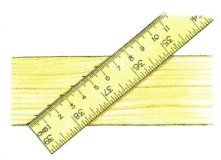
Here's how to divide a board into equal parts lengthwise. Lay a ruler diagonally across the width of the board so that the beginning (0) is at the left edge. Then adjust the other end of the ruler until the right edge of the board aligns with the number of parts desired. Mark off each of the inch/ cm graduations. (As shown in image)
To lay out an exact 90° angle, use the 3-4-5 ratio. From a common point, stretch out two long strings roughly at right angles to each other. Mark one string at 3 ft from the common point and the other at 4 ft. Stretch a tape measure from the 3 ft mark on one string to the 4 ft mark on the other and adjust the strings until the distance between the two marks is exactly 5 ft. The angle between the two strings will be 90°. (This method also works for metres, yards or indeed for any unit of length.)
For fast, approximate measuring, use your own body. on an average size man, the top joint of the index finger is about 1in/25 mm long, the fist is about 4in/100mm wide, and the span from the tip of the thumb to the tip of the little finger on an outstretched hand is about 9in/230mm. A shoe is about 1ft/300mm long.