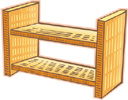
The most useful material for shelving is veneered chipboard, most commonly available with wood or smooth white plastic finishes. This material is not strong, so shelves do need support at about 16in/400mm intervals. For extra support if they are to hold heavy items such as books, run a batten along the wall at the back of each shelf. Or make it stronger by gluing a hardwood strip, the same thickness as the shelf, to the shelf s front edge.
To make a removable shelf, mount folding brackets on the wall. Pull them down and place a board on top when needed.
Build a set of shelves from boards and paint tins. Paint the tins or cover them with matching wrapping or wallpaper.
Clay flowerpots work well for medium weight loads. They look especially nice if you top each 'column' of pots with a potted plant.
For a colourful look, use glass blocks or large jars as shelf supports, filling the jars with marbles or some other bright objects.
Hang shelves with rope from a beam or hooks attached to the ceiling or wall. Drill pairs of holes at the ends of the shelving boards and at all support points, 1in/25 mm from the edges. Knot the end of a length of rope for each hole and slip a washer onto it; then feed the ropes up through the holes in the shelf and knot them again on top. Measure up for the next shelf and repeat the process. Just be sure that when you hang the shelves the ropes are firmly anchored; they may have to bear a lot of weight.